When leadership teams do not perform at their best, everyone suffers. Low employee engagement levels, failure to meet strategic targets, and inconsistent company growth are signs that leadership teams are not highly effective.
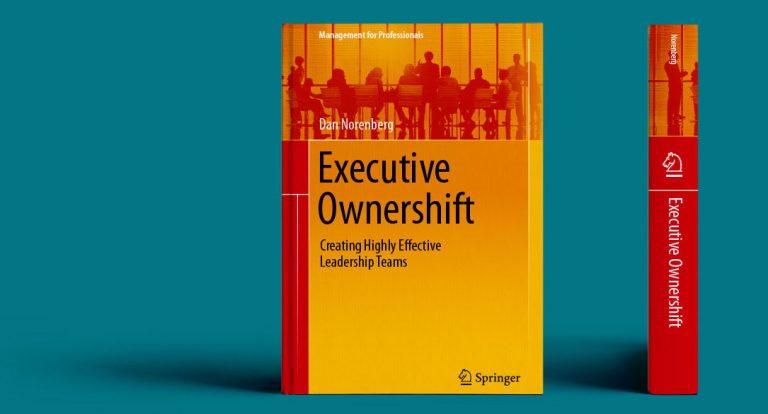
In my book “Executive Ownershift, Creating Highly Effective Leadership Teams”, I share my top-down team approach that enables leadership teams to dramatically improve their performance. While the mainstream continues to focus on leader development at an individual level, I believe that leadership performance and organizational results are best achieved by addressing leadership development as a team of leaders construct. This innovative, six step growth process is called executive ownershift, and is the result of my work with over 100 executive and strategic leadership teams.
You and your team can use the tools and practices in this book to improve performance and results. Whether you read the book from cover to cover or select specific chapter that address the needs of your leadership team, I am confident that you will enjoy and profit from the experiences shared here. Order your copies today and start your executive ownershift.





Continuous improvement, putting the customer first, and breakthrough growth via a senseful strategy are the markers of leadership teams that play at their best.
The problem is; most leadership teams are not playing at their best.
Why not?
Because they are the senior decision-makers and they have a lot on their dashboard. New issues are flying at them all the time. It is easy for them to get distracted and move away from their leadership agenda.
In these leadership teams, there’s a lot at stake. There’s a lot of power and not much trust. A senior leader isn’t going to tell their colleagues, “I’m not sure how to handle this situation.” And if someone does say, “I have a problem,” they do it in a confessional way with a coach, so no one else knows about it.
There’s a layer of insulation that prevents executive leaders from hearing the honest truth about how others perceive them and the real state of the business. Too often leaders get good news that keeps them happy, yet distracted from the issues that could help their business really shine.
What’s more, HR can’t give the executive leadership team much help. Rarely does human resources have the standing to challenge senior leadership’s capability or performance as they report into these senior executive teams.
Leadership teams who work with me go through a dynamic learning process called Executive Ownershift®, enabling them to clarify and reown their executive agenda, the starting point for breakthrough results. I am convinced that if you really want to get ahead of your competition, and stay ahead as a market leader, this is the only place you can start. Everything starts with the leadership team. Anything else is a distraction.
Clients Voices
Dan Norenberg is an extraordinary mentor and resource for both new and seasoned executives looking to consolidate and strengthen their leadership teams.
Marlou Janssen, President, BIOTRONIK, Inc.
The learning experience with Dan helped our teams become even stronger, cohesive and efficient. All of the plants’ performance metrics improved and each site is now focused on helping each other, which can be credited to Dan’s great support.
Chris Olson, Head of Global Manufacturing & Supply; Ciba Vision
Dan has done an outstanding job and has given us a great set of tools on our way to becoming an excellent leadership team.
Frank Wiemer, CEO at IWIS Motorsysteme
You helped us to create a crisper picture of what our organization should look like and increased the collaboration and alignment of our business lines. Whenever we are again facing new challenges you and your team will be our first contact address.
Jürgen Gerke, CEO; Allianz Capital Partners
Executive Leaders
Can you say this about your leadership team?
- High performance and exceptional results in our business can be directly linked to the effectiveness of our executive team.
- The leadership behaviors in our executive team excite and engage people in our organization.
- Our executive team collaborates and supports each other in such a way that it sets the positive example for others in our company.
- Our executive team leads the most effective meetings in our company.
- Our business strategy is clear and emotionally compelling, due to the effort and example set by the executive team.
- Our executive leadership team is playing at its best.
Executive leaders that strive for excellence recognize that growth and breakthrough performance starts with executive and senior leadership teams.
If you can’t strongly agree with the statements above, yet aspire to become the catalyst for change and performance in your organization, contact me and I’ll be happy to share how you can dramatically improve your leadership team performance and your organizational results.